Resources (Maker Spaces):
JUMP in Boise: https://jumpboise.org/studio-community-projects
Gizmo in CdA: GIZMO-CDA – Home
National Invention Convention curriculum K-12: https://inhub.thehenryford.org/curriculum-resources/invention-convention-curriculum
FREE Electric Vehicle Engineering Workshop presented by National Invention Convention winner Vibodh Ayyapureddi:
BOOKS
Little Red the Inventor book by Jennifer S. Mead: excellent resource for educators especially for younger children. https://www.amazon.com/s?k=Little+Red+the+Inventor&i=digital-text&crid=TQSW9Z4K2KPQ&sprefix=little+red+the+inventor%2Cdigital-text%2C234&ref=nb_sb_noss_1
Logbook Examples:
National Invention Convention Best Notebook 2020 Julianna Schwam: https://www.dropbox.com/s/a7g0lh6collwafx/Schwam%2C%20Julianna%281%29.pdf?dl=0
Resources:
Teacher Training Videos:
– Part 1: https://www.youtube.com/watch?v=xq5MJO13qkA
– Part 2: https://youtu.be/vtDK_pHPWmU
– Part 3: https://youtu.be/kVFY9pNArfQ
– Part 4: https://youtu.be/bHc_-NpJAqg – Part 5: https://youtu.be/MnAE39j1JVs
Pitch Video Examples:
| Katherine |
| Limb Regeneration Apparatus |
| https://www.youtube.com/watch?v=wVdMAGuCjZk |
| Lily |
| Solar Lines |
| https://youtu.be/Q78Jl7ffe7M |
| Jolie |
| Sleep-P-Safe |
| https://youtu.be/E5661ne0Ay0 |
| Amiah |
| Flush Away Wash Away Germs |
| https://www.youtube.com/watch?v=nfD7bMzzaPU |
| Caleb |
| Organ Printer |
| https://youtu.be/g4tu4oaq_GU |
| Vibodh |
| Alzeron |
| https://youtu.be/tDnZtg0_8DI |
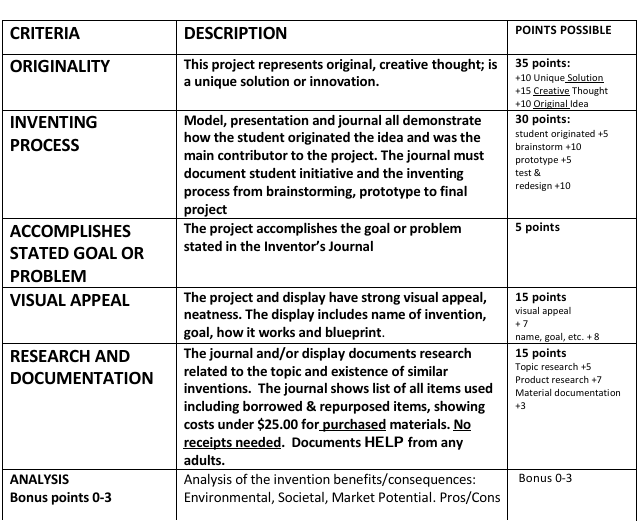
Invent Idaho Judging Criteria Grades 1-8:
High School Judging Criteria Grades 9-12:
I. DESIGN CHALLENGE PROBLEM STATEMENT= +5 points
A. Clearly defined = +3 points
B. Why this problem was selected = +2 points
II. IDEATION = +10 points
A. Details numerous possible design solution ideas
III. RESEARCH = +15 points
A. Demonstrates new learning about the topic = +3 points
B. Includes interviews with target audience individuals prior to
solution creation = +5 points
C. Includes interviews with target audience individuals after
Production = +4 points
D. Identifies a mentor and delineates contributions provided by
Mentor = +3 points
IV. EMPATHY FOR TARGET USERS IS EVIDENT THROUGH DOCUMENTATION =
+2 points
V. 3-D PROTOTYPE = +25
A. Initial design sketch included = +5 points
1
B. CAD (Computer Aided Design) Diagram included = +5 points
C. Working Model = +15 points Non-Working Model = + 5 points
VI. EVOLUTION: TEST , REVISE, and REDESIGN = +20 points
A. Documents feedback from target audience about prototype
effectiveness and defects = +5 points
B. Shows evidence of redesign modifications based on tests and
Feedback = + 15 points
VII. ANALYSIS = +3 points
A. Documents higher level thinking to interpret feedback during
and after the process regarding benefits to society, effects
on the environment, technology that still needs to be
perfected for this invention to be produced, limitations for
potential markets, and other pertinent information.
VIII. SHARING = +20 points
A. Shows evidence of sharing with the community to build
Partnerships = +2 points
B. Provides a print advertisement of the product = + 2 points
C. Provides a professional looking, quality display documenting design process and
benefits of the invention = +8 points
D. Provides a video with a clear purpose, documenting the
design process and benefits of the invention = +8 points
Invent Idaho Rules:
The idea of the invention must be student initiated. Guidance* from parents, adults, or friends is acceptable but must be fully documented in the Inventor’s Journal. Student must do all work that he/she can safely do at the child’s age. The original idea must be the student’s own. Names and faces are permitted on display and in notebook with permission from adults.
- The overall theme of the invention must enhance the quality of life and be humane.
- Each invention must include a three-dimensional model, prototype, or the actual invention.
- A free-standing display (not wall poster) is required. Display must include name of invention, blueprints or diagram, goal or problem invention solves, and how the invention works or functions. Pictures or photos are encouraged.
- Cost of new materials is not to exceed $25.00 for the model or prototype. Display board and journal do not count in cost. Journal must document donated, borrowed, or repurposed materials and list costs of newly-purchased items. No receipts are needed.
- An Inventor’s Journal must accompany the invention. In the journal, students should document the inventing process from brainstorming through prototypes, and show how they have met the judging criteria. Neatly hand-written journals are encouraged.
- Inventions in any category may be entered by individuals or by teams of students. Mixed grade level teams must register in the grade division of the oldest member. No more than 4 students per team. Note: if selected to win an award, one award is presented to the PROJECT.
- Inventions from prior years will not be accepted.
- All inventions grades 1-8 will be judged by the same criteria. High school judging criteria are slightly modified to include a CAD drawing and a video.
- No weapons or weapon systems; defensive systems are acceptable.
- *NOTE: Students are expected to do all work themselves, except in issues of safety. Parent guidance is best done by asking questions—not doing it for the child. Plagiarism is not acceptable. Adult help must be documented.
GRADE DIVSIONS 1 & 2 3&4 5&6 7&8 9-12
Invent Idaho Categories:
All inventions may be conceived, designed, and entered by individuals or teams in any of the following categories. Note: One award is given to the PROJECT. Additional awards for teams may be purchased.
WORKING MODELS This category includes projects where students have produced a full-size or scaled working model or sample of the invention that really works. The invention must accomplish a state goal or purpose. Note: Size restrictions of models for National Invention Convention if qualified: 48” wide and 36” tall/ not encroach on other displays.
NON-WORKING MODELS This category is for inventions that would be too large, expensive, or technical to build. Entries in this category must be more than just a drawing; each entry must include a “blueprint” as well as a three-dimensional model or sample, which does not actually function.
ADAPTATIONS This is an invention, which takes an idea already in existence and improves upon it. A three-dimensional sample or model of the adaptation is required. “New and Improved!” is the slogan for these inventions.
GADGETS AND GAMES NEW! “Gadgets” are ingenious and novel devices or toys, for the purpose of entertainment, education, or amusement. This category also includes original board, computer, and other digitally-produced games, designed and programmed by the student inventor, as well as sports or athletic games and activities. Examples of all the above games and gadgets along with full directions for playing are required. Inventors must provide all necessary technology and equipment for judging, as well as devices to secure it.
JULES VERNE!! This category encompasses projects that would fit into any other category but are too futuristic or fanciful to be judged against more practical inventions. This is the futuristic category and will be judged heavily on originality and imagination. Future space, medical, and scientific inventions would be examples of projects for this category.
*All projects must be accompanied by a neat, fully detailed 8.5″ by 11″ drawing (or larger) and a 3-D model representing the invention idea. *Entrants are responsible for determining which category is the best fit for their invention. *An Inventor’s Journal must accompany every invention. This journal thoroughly details the entire invention process and documents the student’s journey from the idea’s conception, through various prototypes, to testing/revising and completed model. GRADE LEVEL DIVISIONS:
GRADES 1-2; GRADES 3 – 4; GRADES 5 – 6; GRADES 7 – 8
HIGH SCHOOL GRADES 9-12 *not subdivided into categories with less than 20 entries.
NOTE: Plagiarism is illegal and unacceptable. Invent Idaho takes plagiarism very seriously and it will not be tolerated. Have your young inventor research and document that their idea is original, how they thought of the idea, and how their invention is different than existing inventions. If you are concerned about protecting your idea, contact the US Patent Office and inquire about a Patent or Provisional Patent. Plagiarism is not in the spirit of Invent Idaho where we celebrate creativity and the inventive process, not just the award. Parents, please realize that when you are overly involved with the inventive process, rather than just a guide on the side, you are telling your child you do not have faith in their ability to do the job, and, thus, undermining their self-confidence. Plagiarism may result in the forfeiture of awards and denial of future participation in the Invent Idaho program.